My job as a data analyst in PR used to be quite simple, finding out how effective communicators have been in connecting with their stakeholders through data.
The usual suspects where stakeholders are concerned are consumers of one segment or another, regulators, politicians, NGOs and communities for B2C clients, business and trade organizations and professions for B2B clients.
It’s a well trodden path as these stakeholders have been around for decades.
Lately, however, a new and important stakeholder that threatens to give all the established players a run for their money has come to town: Generative AI.
It’s a stakeholder because it influences the other stakeholders, particularly consumers. Whether we like it or not, people have started listening to and trusting it. It also has its own peculiar preferences on what it considers important.
The End of the "Ten Blue Links"
For twenty years, the internet was a library. If a person wanted to know if your company was sustainable, or if your product is reliable , they went to a search engine. They got a list of ten blue links. They had to click. They had to read and decide which are the best answers.
Now, people do not search with keywords. They ask questions instead.
They ask ChatGPT, or Claude, or Gemini questions such as “Is Company X a good investment?” or “Tell me about the scandals involving Brand Y.” And the machine answers.
It does not give a list of links, it gives a paragraph. It speaks with seemingly a high level of authority and confidence. Sometimes it tells the truth. Sometimes it hallucinates, but at all times it offers frictionless speed and convenience in the answers it dishes up. No wonder modern humans are getting more attracted to this new influencer (see: similarweb, 2025).
AI answers come from fresh data every day. It does not just fetch answers like search engines, it generates them based on the prompts of what the user is asking. Its tone is convincing regardless of the veracity of the sourced information, It has one terrible compulsion: it must answer.
And that is the peculiarity. Different from search engines where it can display “no result”, the moment we stop being relevant, AI does not politely decline to comment. It often fills the void. It starts quoting the competition. Or worse, it digs up the skeletons we thought we buried years ago.
As such, many communicators are asking how they can manage to influence this new stakeholder.
Same Game, New Player
After months of managing and analyzing data from hundreds of AI prompts, how to influence this influencer is disappointingly simple: all you have to do is crank up your PR and secure lots of earned media coverage.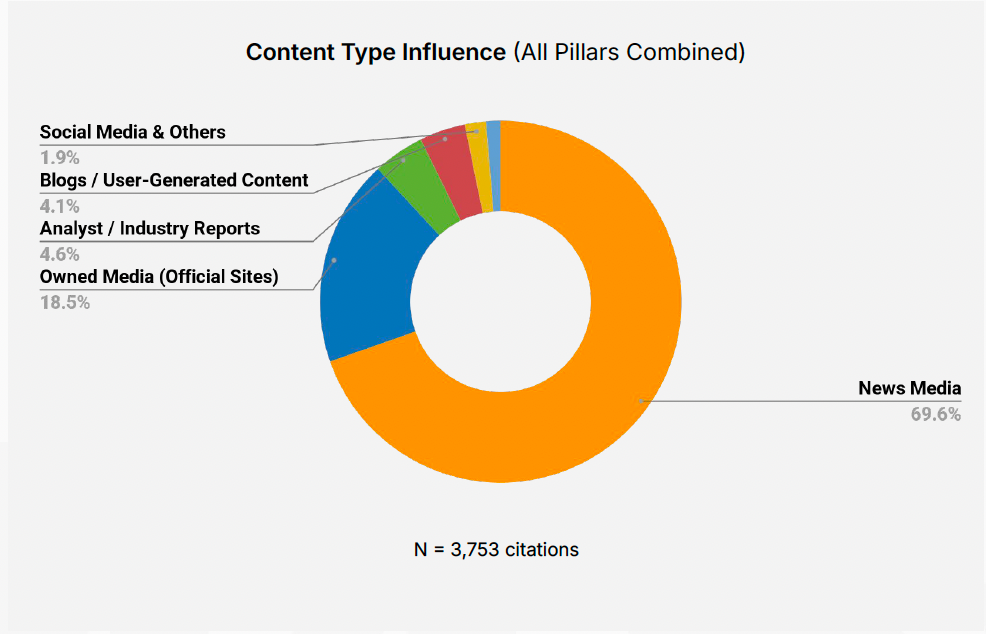
(see: Maverick Indonesia’s AI visibility whitepaper for full research document)
This clarifies the job: to steer the algorithm, you must steer its source. Right now, that source is the press. But even if the data shifted tomorrow, say, the machines started favoring social media conversation, the game remains identical. You simply pivot to steering the conversation there. The medium is variable but the logic is the same.
But let’s be real. No client pays their employees with "ChatGPT Sentiment Scores." You cannot buy a factory with a Perplexity citation. These metrics are vanity unless they influence the only stakeholder capable of signing a check or contract: the consumer or the “human” stakeholder.
AI data is just another input. It sits there, until it is woven into a holistic strategy. Whether the medium is radio, newsprint, social media, or telepathy, the mandate remains the same. In the end, this is simply a new level in the game to prove one thing: excellent PR is excellent PR.