Journalists concerned over the unregulated and unchecked use of AI jumped from 18% to 26% this year, according to the Muck Rack’s State of Journalism 2026 report. This global anxiety perfectly mirrors the reality faced by journalists in Indonesia, where 45% of reporters now view AI with deep caution due to its potential threat to journalistic integrity.
Yet, a massive paradox define s both spheres. Globally, AI adoption has reached an overwhelming 82%. Locally, 75% of Indonesian reporters rely on these exact tools to survive an industry plagued by impossible workloads.
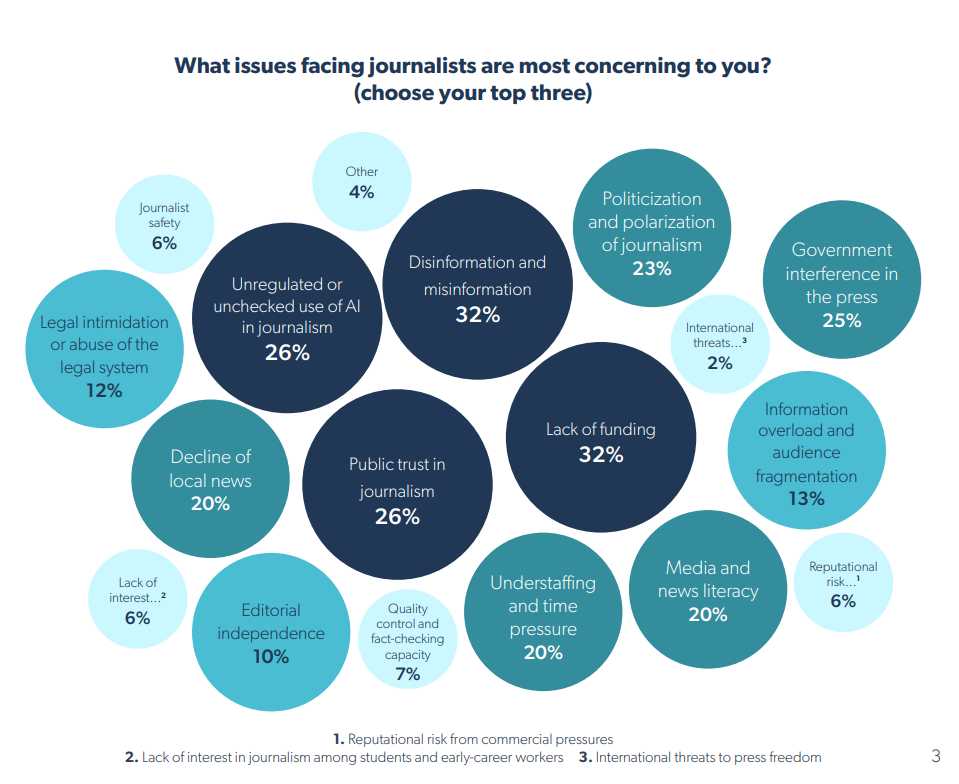
The root of this anxiety is a fundamental crisis of credibility. Muck Rack data reveals that global fears over unchecked AI now tie exactly with concerns about declining public trust in journalism.
In Indonesia, reporters point to specific functional flaws driving this fear. Local journalists worry about the erosion of professional values because AI systems consistently lack credibility in fact verification and struggle to retrieve accurate live results.
Technology threatens the core currency of news reporting, which is the truth.
The Survival Mechanism
Why force the adoption of technology that threatens journalistic credibility? The answer is pure exhaustion. The Muck Rack report indicates 47% of journalists globally describe their daily work as exhausting.
In Indonesia, this exhaustion is quantified by extreme daily quotas. Editors and reporters frequently face the crushing task of producing 25 to 45 articles every single day. Under this immense pressure, AI is a mandatory survival mechanism.
Indonesian journalists lean so heavily on generative tools to manage these quotas that some even address their chatbots with affectionate nicknames like "sayang" or "bro".
The Policy Void
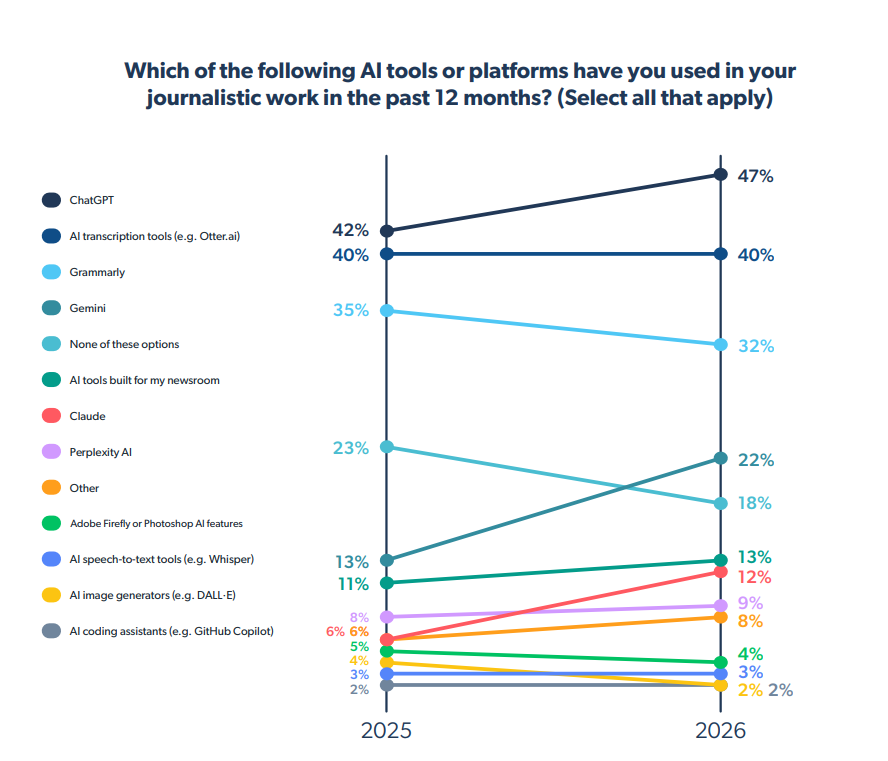
The tools of choice are identical across borders, but they currently operate in a dangerous vacuum. Global ChatGPT usage has climbed to 47%, while Gemini nearly doubled to 22%.
In Indonesia, 86% use ChatGPT and 63% utilize Gemini to handle the mechanical heavy lifting of drafting and transcribing.
However, over half of Indonesian newsrooms function with absolutely no written standard operating procedures for AI use. Furthermore, 43% of local journalists have never received formal training. Reporters are wielding powerful technology without institutional guardrails.
The Human Premium
However, this mechanical efficiency highlights exactly what AI cannot do. The Muck Rack data reveals that 78% of journalists define a story as genuinely relevant only when it directly affects the local community their audience belongs to.
You cannot automate cultural context. You cannot prompt a chatbot to build trust with a vulnerable source. By outsourcing the repetitive busywork to generative tools, reporters are desperately trying to buy back the time they need to do actual, human journalism.
The true value of a reporter is no longer in how fast they can type, but in who they know on the ground.
The journalism industry stands at a critical crossroads. AI offers a necessary lifeline for exhausted reporters drowning in extreme daily quotas.
However, it cannot replace the human connection required to truly understand a community. If newsrooms continue to operate in this unregulated territory, they risk sacrificing the only currency that matters.
Technology can generate content, but only human journalists can build trust.