For an illustration of the power of the narrative, look no further than Hotman Paris, the celebrity lawyer hosting legal and celebrity talkshows.
Hotman has always been Hotman. Loud, brash, lewd and mysoginistic with women, a show-off when it comes to rings and cars, a conniosser of garish clothes and owner of a chain of nightspots.
All these flaws have been in flagrant display to the public, who was generally OK with it, because the narrative about Hotman was that he was, inspite of everything, a Defender of the People. Pembela Rakyat, a Robin Hood hero of sorts.
It is a narrative that Hotman has carefully curated through his highly publicized talkshows where he dispenses for free to underdogs free legal advice that he likes to remind us, are astronomical.
Then he decides to defend Fabrie Ardiansyah, the Chief Prosecutor who to most people think is guilty as hell of corruption after a police raid at his house yielded Rp476 billion and 74kg of gold bars. The police also raised a cafe where they found Rp 60 billion behind a hidden safe behind second-floor cupboard.
And just like that the narrative changed. From Robin Hood he became the Sheriff, a villain, a symbol of what is wrong with the elite. One this took place it is difficult for Hotman to get away with what he’s always got away with. For he’s now scrutinized from the narrative that he’s a Sheriff.
And that’s the power of narratives. They work like lenses. Often you don't see the person, especially if that person is a celebrity and difficult to get access to.
You see them through the story the narrative sets up. Narratives are also a heuristic. Our brains are naturally easy so clutches on to anything that can lighten its thinking load. Here, narratives assign archetypes, pre-built roles, to people. Once that sets, every action and word uttered by that person get’s interpreted through the archetype logic.
Hence the narrative around Hotman was that he’s a hero, so people interpreted his excesses as peccadilloes, minor faults of essentially good person. But when the narrative changed, as it has, he’s now a villain and everything he says or does is interpreted through that lens.
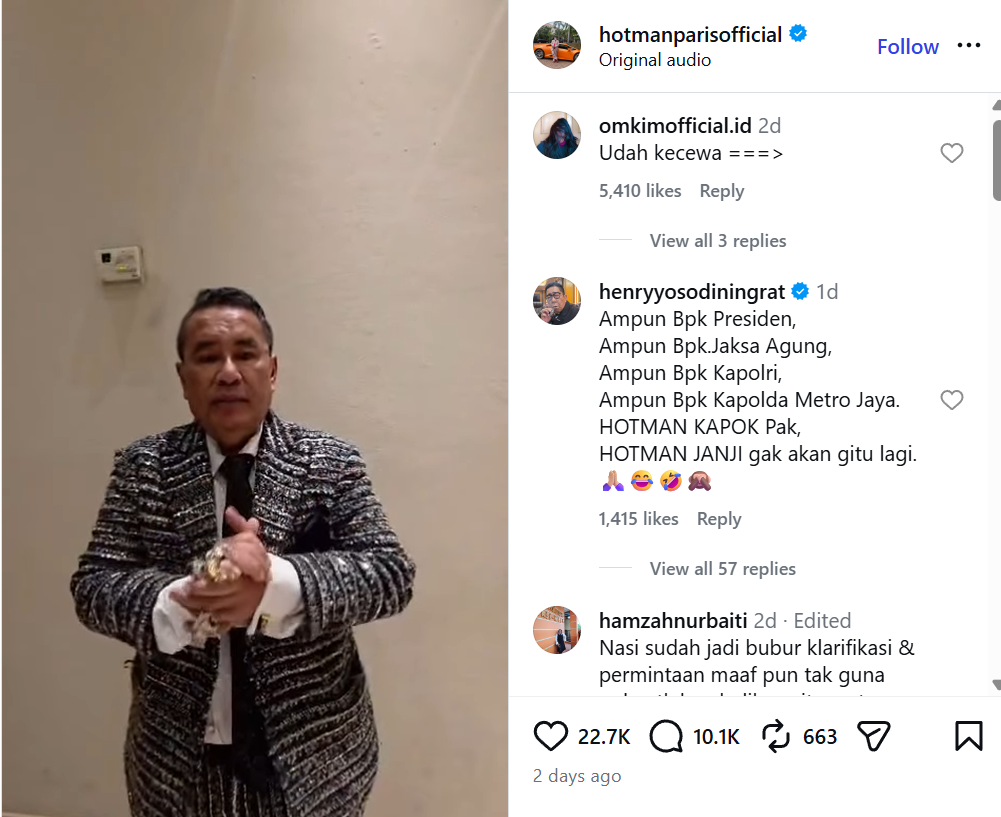
Hotman will from now on be facing a tough time in anything he says or does because of the changed narrative, not that he’s doing himself any favors by delivering apologies without contrition and blaming circumstances instead, or indiscriminately invoking the name of the President and tycoons.
This is an important and often overlooked element in the management of communication, especially in today’s environment when Zero Clicks is fast eroding the viewership of the legacy media, when AI interprets news and when social media remains a babel of voices. Individual stories in the form of news impressions, social media reach and engagement cease to matter very much as communication metrics.
Rather what is emerging as important are the narratives, the stories being told about an organization, person or brand — that become the lens through which they are perceived. Media monitoring and media intelligence has now been surpassed by narrative intelligence.