On the evening of April 27, 2026, a Green SM electric taxi stalled on an active railway crossing at Bekasi Timur Station, West Java. The driver had been on the job for two days. He had one day of training.
The chain reaction that followed killed 16 women.
What happened next on the tracks was a tragedy. What happened next in Green SM’s boardroom was a case study in how not to lead.
The Empty Chair
Within hours of the crash, Green SM’s communications team issued a text statement on Instagram, with comments disabled.
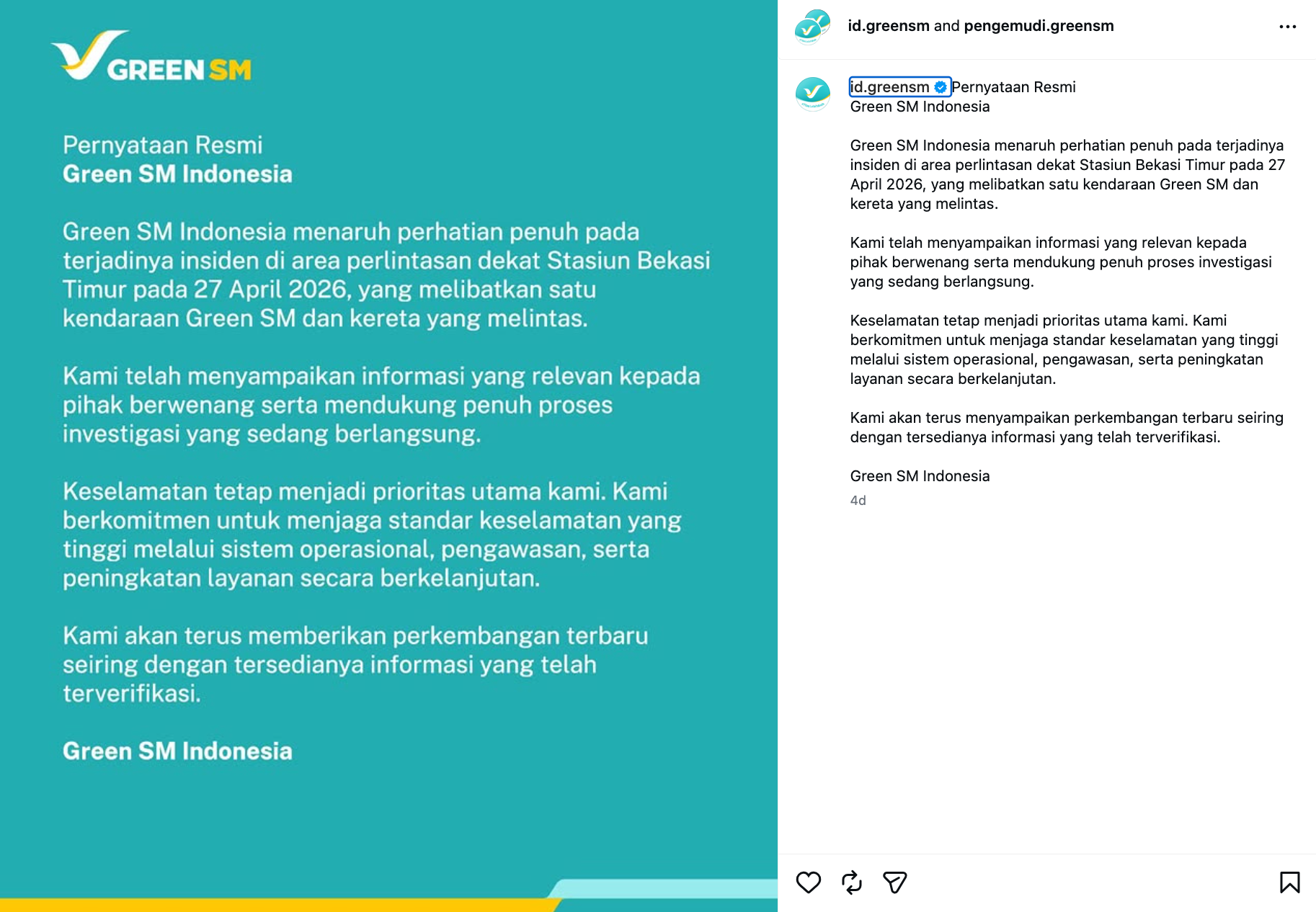
No executive appeared. No apology was given. The company’s leadership was invisible at the moment the public needed to see them most.
Hours later, under mounting public pressure, a revised statement offered “deepest condolences.” The comment section reopened. But the damage was done.
In a crisis, timing is everything. The first hours are like the first chapter of a book, people form their judgments and rarely revise them. Green SM spent those hours hiding.
The Contrast Next Door
The same crash involved PT Kereta Api Indonesia (KAI). Its CEO, Bobby Rasyidin, drove straight to Bekasi Timur Station.
He stood at the crash site through an eight-hour evacuation. He held an open press conference on location. He said: “We endlessly ask for the deepest apologies to the whole community for this incident which caused casualties.”
That is the entire difference. One CEO showed up. The other didn’t.
Why Presence Matters More Than Statements
Crisis communications experts have a term for what Green SM did: the bunker mentality. Go quiet. Control the message. Wait for the storm to pass.
It never works and it especially doesn’t work in Indonesia.
Indonesian society is built on gotong royong, the principle of mutual support and communal responsibility. Empathy here is not expressed through press releases. It is shown through physical presence. A leader who does not appear is a leader who does not care. That is the public read, and it sticks.
Green SM let a PR team act as a megaphone while 16 families were in mourning. The public didn’t just notice, they amplified it.
Silence Goes Viral
In a crisis, silence is not neutral. It is a statement.
When Green SM disabled comments on its first post, it handed over control of its own narrative. The public, the media, and social networks filled the vacuum on their own terms.
This is the iron rule of crisis communications: if you don’t tell your story, someone else will. And they won’t be kind.
The way to develop an appropriate crisis response is to answer the question, "What would reasonable people appropriately expect a responsible organization or leader to do when facing this kind of situation?" And then you should do exactly that.
Reasonable people probably wouldn't expect your organization to have all of the answers immediately, but they will expect you to indicate what steps you're taking to resolve the problem and to make sure it's clear that you care.
A company does not need all the answers in the first hours. Investigations take time. Facts take time. But acknowledgment takes seconds. Empathy costs nothing. A CEO at a crash site sends a signal no press release can replicate: we are accountable, and we are here.
The Bottom Line
Green SM markets itself on clean technology and silent engines. But when 16 people died at a railway crossing, executive silence was not a feature. It was a failure.
Leadership visibility in a crisis is not a soft skill. It is a strategic necessity. Companies that treat it as optional tend to find out, too late, that the court of public opinion moves faster than any investigation.
Bobby Rasyidin understood this. He got in the car and went to the scene.
Green SM’s leadership, however, did not.. And the public noticed every minute of it.