If you're a CMO, here's a question worth pondering: where does the more immediate threat from AI actually lie?
Is it making you and your team redundant, automating the work your department does until there's little left to justify the headcount?
Or is it something quieter, but arguably more disruptive: forcing a complete reckoning with success metrics and visibility standards that didn't exist five years ago, ones that most marketing leaders still haven't fully addressed?
According to the Forbes Research 2026 CxO Growth Survey, the top challenges CMOs face right now are keeping pace with rapid tech change and AI (55%) and anticipating changing customer behaviors (46%).
Most boardrooms and marketing conferences have been preoccupied with the first challenge. The second is where the real disruption is quietly happening.
AI Isn't Coming for Your Job as CMO. It's Coming for Your Excuses
In marketing strategy sessions over the past two years, a pattern has become hard to ignore.
Someone brings up AI. The room tenses slightly. And almost immediately, the conversation lands in the same place: are we going to be replaced?
The question of redundancy feels urgent, especially with Forrester forecasting that 7.5% of advertising agency jobs (around 33,000 roles) will be automated by 2030. But it's the wrong primary question.
The more uncomfortable question, the one marketing leaders are collectively avoiding, is this: are we actually accountable for the right things anymore?
AI isn't primarily disrupting marketing by automating jobs. It's disrupting it by exposing gaps in brand clarity, content credibility, and the consistency of how brands show up, which traditional metrics were never designed to catch.
Something Shifted. Most Teams Haven't Caught Up
When ranking on Google felt like the whole game, the formula was complicated, but at least it was legible. Get the right keywords, build the right pages, earn the right links.
Then something changed quietly.
A growing portion of audiences stopped clicking through search results. They started asking ChatGPT. Or Perplexity. Or Gemini. And those platforms don't show a list of links, they synthesize an answer. They decide what's worth including, what's worth citing, and what gets left out entirely.
That's a fundamentally different dynamic. And it changes what it means for a brand to "perform well."
Brands with strong campaign numbers, healthy traffic, and solid traditional media share of voice can still show up vague, generic, or quietly steered toward a competitor when an AI system is asked about them. No algorithm update to blame. No obvious failure point. Just a slow, invisible erosion of relevance at the exact moment a potential customer is forming an opinion.
What I've Started Calling the Legibility Problem
There's a word that didn't use to belong in marketing vocabulary: legibility.
Can an AI system actually read a brand clearly enough to represent it accurately?
Not just find it. Understand it. Know what it stands for, what category it belongs to, what makes it credible, who backs up its claims.
When brands are audited through this lens, across multiple categories, the patterns are surprisingly consistent. Brands that have let their messaging drift across channels, buried important proof points in inaccessible formats, or built bold positioning without accessible third-party validation are the ones that show up poorly. Not because they're weak brands. Because AI systems can't synthesize the signal clearly enough to cite them with confidence.
That's the legibility problem. And it's a CMO problem.
The New Questions I Think We Have to Own
This isn't something to hand over to the tech team or fold into an SEO retainer. Brand representation in AI environments is a leadership question, and it sits at the intersection of everything a CMO is supposed to be accountable for.
Every strategy review now deserves a new set of questions:
- What does AI say about us today, not what do we say about ourselves?
- Which sources are shaping that answer, and is there any real influence over them?
- Is the brand narrative consistent enough, across owned content, earned media, and shared channels, for an AI system to interpret it without ambiguity?
- Do the most important claims have credible, accessible, citable support? Or are we asking AI to take our word for it?
These questions don't replace the metrics marketing leaders have always worked with. But they add a layer no CMO can afford to skip.
What GEO Actually Means in Practice
When the term Generative Engine Optimization (GEO) first entered the conversation, the instinct was to treat it as a rebranding exercise, SEO with a new coat of paint.
It isn't.
The technical layer exists. But the real work of GEO is fundamentally cross-functional. It's about ensuring PR (earned media), content, brand, and digital governance all contribute to the same coherent signal, because AI systems learn about a brand from everything, not just its website.
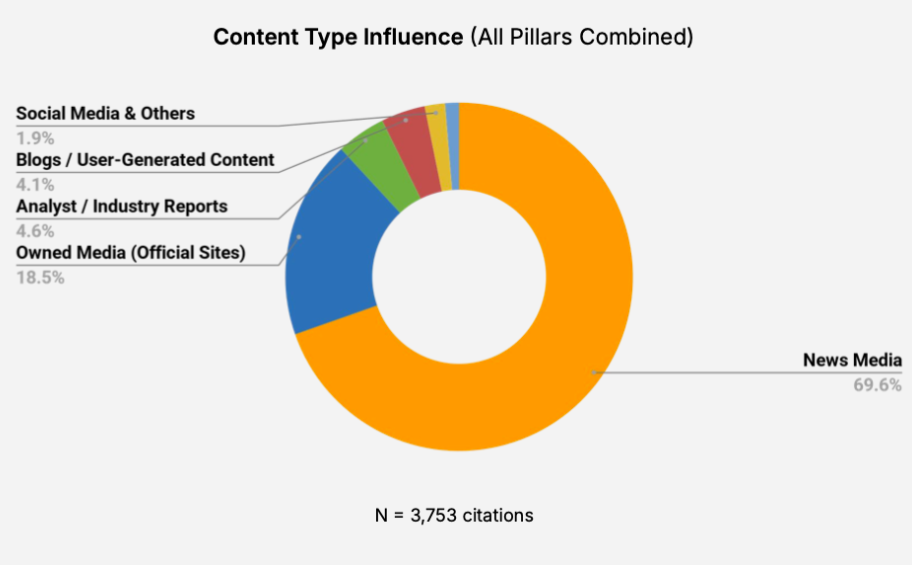
Based on our reports consider the numbers: earned media remains the definitive anchor of credibility, driving roughly 70% of AI citations. But narrative clarity, the specifics of your products, policies, and stances, comes from your owned channels, which account for 18.5% of overall citations. In highly technical areas, such as Data Security, owned media's influence skyrockets, making up 63% of the sources AI relies on.
Furthermore, you can't treat all AI engines the same because each platform has its own "reading habits". For example, Gemini leans heavily on journalism, pulling over 90% of its citations from news media. In contrast, Grok 3 pulls 30% of its citations directly from official brand websites.
The credibility signals AI trusts most come from earned media. Narrative clarity comes from content strategy. The consistency that makes synthesis possible comes from brand governance. And the verifiability that gives AI systems confidence to cite a brand, rather than hedge, comes from having accessible, attributable proof points behind every important claim.
None of that lives in one team. All of it lives in the CMO's orbit.
The Accountability Shift Is Already Here
Smart marketing leaders have underestimated this shift, and the cost of that underestimation compounds quietly over time.
The brands that figure this out first won't necessarily be the ones with the biggest budgets or the most sophisticated tech stacks. They'll be the ones with the clearest sense of who they are, the most consistent way of expressing it, and the discipline to make sure that clarity shows up everywhere, including in the places AI systems are looking.
That's always been good brand leadership. AI is just raising the stakes for it.
The redundancy question will keep circulating. It makes for good content. But the attention that matters right now is on a different question entirely: are the brands we steward legible enough, credible enough, consistent enough, well-sourced enough to be accurately represented by systems quietly shaping how audiences form opinions before they ever reach us?
That's the question CMOs need to be sitting with.