For the last 2 years, much of the conversation around Generative Engine Optimization (GEO) has focused on one question: what does AI know about your brand?
So brands worked on the obvious things. They optimized their websites, published more useful content, earned media coverage and tried to make sure AI could find enough credible information about them across the web.
With Personal Intelligence, Google AI Mode can use a person’s previous searches and, when connected, information from apps such as Gmail and Google Photos to tailor its responses. Google itself gives examples of AI Mode recommending products based on brands someone has previously bought or suggesting places based on information already sitting in their Google account.
Now when two people asking exactly the same question: “What is the best PR agency in Indonesia?”
One has never heard of your agency. The other has attended your event, interacted with your content and has emails from your brand sitting in their inbox.
Would AI recommend the same agencies to both of them? Increasingly, we may need to consider that the answer is no.
And if that is where search is heading, GEO is no longer just about making sure AI understands your brand. It may also be about whether AI understands why your brand is relevant to the person asking.
Personal Intelligence changes what “relevance” means
This is where things get interesting.
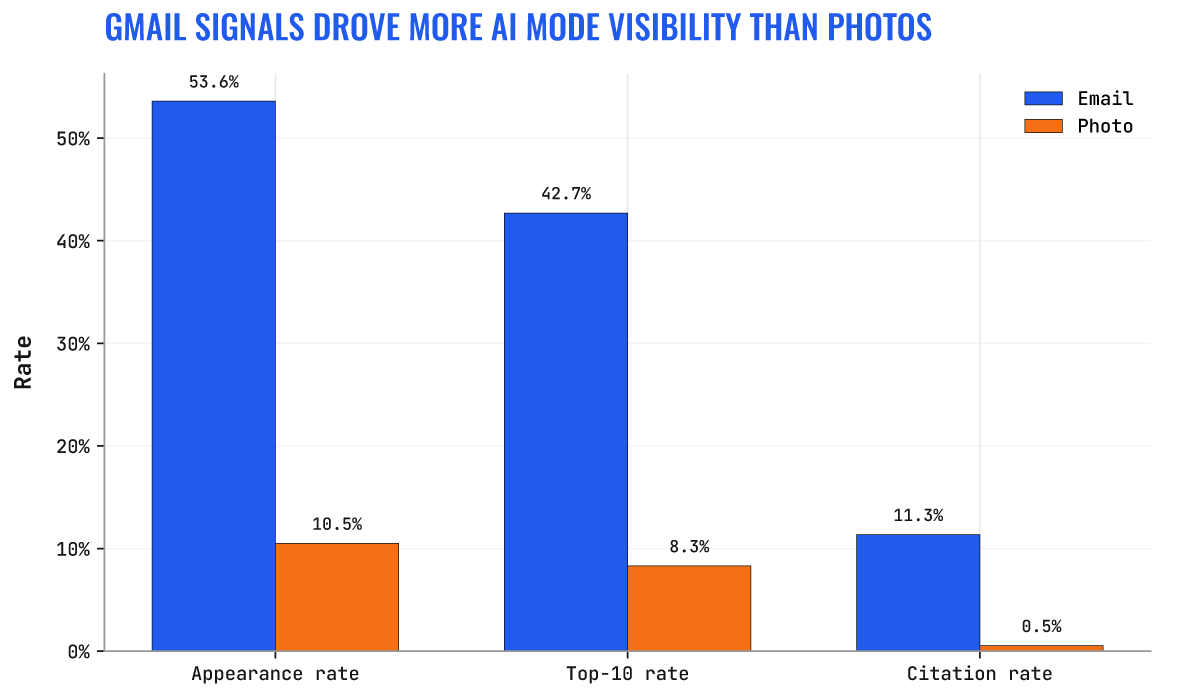
In a recent experiment, iPullRank tested whether information stored in a user’s Google account could change what Google AI Mode recommends. They seeded selected brands into Gmail and Google Photos, then compared the answers against a control account with no Personal Intelligence connected.
The difference was hard to ignore. Brands seeded into the Personal Intelligence account became significantly more likely to appear in AI Mode responses. Gmail was particularly influential, with email-seeded brands appearing in 53.6% of relevant responses.
But the more important takeaway is not that email has suddenly become a new ranking hack.
It is that relevance may no longer be determined only by what exists on the public web.
Until now, a brand’s visibility in search has largely depended on signals everyone could theoretically access: websites, media coverage, reviews, citations and other publicly available information.
Personal Intelligence introduces something different. Google can now potentially factor in context that belongs to one person: previous interactions, information in their inbox and other signals tied to their own history.
That means two brands can be equally credible on the web, yet one may still be more relevant to a particular user because there is already a relationship there.
And that changes the question GEO experts need to ask. Not just “Does AI know enough about our brand?”, but also: “Does AI have a reason to consider our brand relevant to this person?”
Being relevant is not the same as being credible
There is another finding in the iPullRank experiment that deserves more attention.
The researchers created fictional brands with no real website, reviews, media coverage or other public footprint, then introduced them through the same Gmail seeding process. Surprisingly, those fictional brands still appeared in 35.7% of relevant AI Mode responses. Real brands performed better at 55.8%.
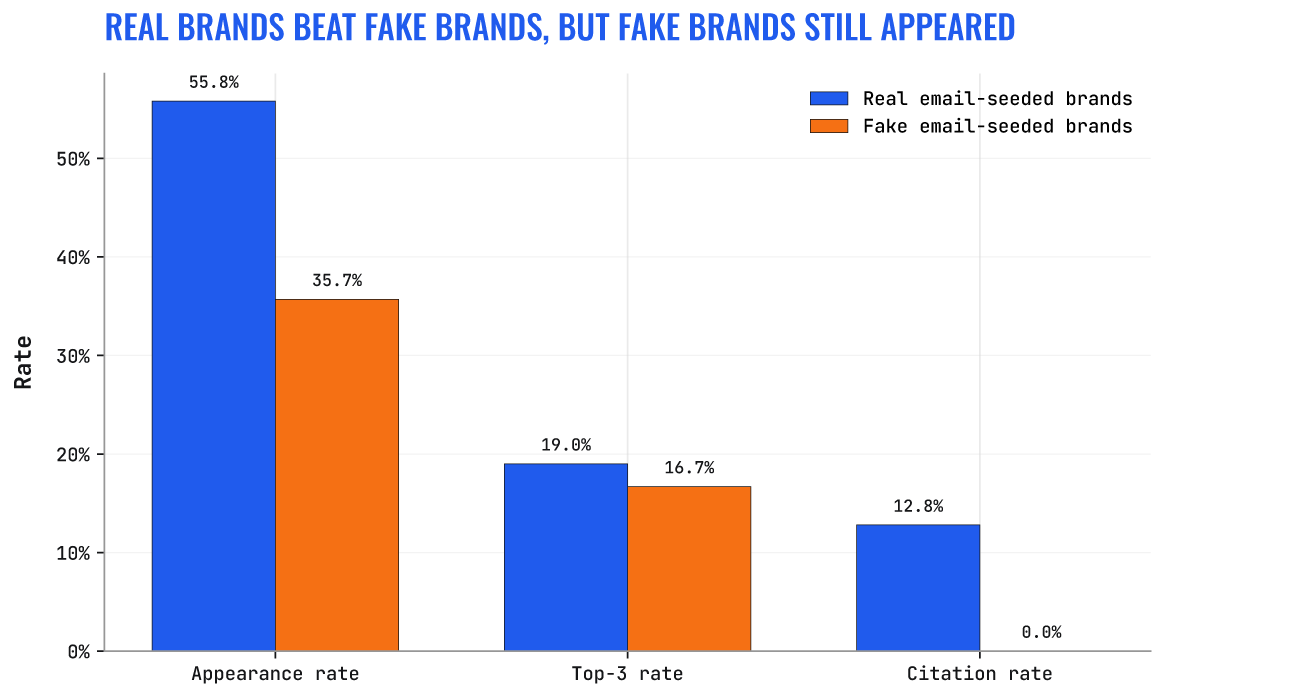
That tells us personal context may be powerful enough to put an unfamiliar brand into consideration. But there was a catch.
The fictional brands received zero citations. There was simply nothing on the public web for AI Mode to use as evidence. Real brands, by contrast, came with websites, product information, third-party mentions and other sources that could support what the AI was saying.
This points to an important distinction. Personal relevance can get a brand noticed. Public authority gives AI a reason to trust it.
For brands, that means the rise of personalized AI does not make websites, SEO or PR less important. If anything, it makes the relationship between them more important.
A customer may already know your brand. Their inbox may even give AI a reason to consider it. But when that customer asks for the “best PR agency in Indonesia” or a reliable partner for media training, AI still needs public evidence that the brand deserves to be there.
The wrong takeaway is to optimize the inbox
The obvious response to this research would be to treat Gmail as the next search surface.
Send more emails. Mention the brand more often. Repeat the category you want to be associated with. Hope that AI remembers.
That would be a remarkably quick way to learn the wrong lesson.
iPullRank does point to lifecycle communications such as product education, receipts, onboarding, renewal notices and newsletters as touchpoints that may become part of the personal context available to AI. But these were implications drawn from the experiment, not proof that every type of marketing email improves AI visibility.
The emails actually tested were short, recommendation-style messages deliberately written to connect a brand with a category and a reason to choose it. More importantly, an inbox is not a publishing platform. It is part of a relationship.
If brands start treating it like another place to stuff themselves into an algorithm, the strategy defeats itself. People can unsubscribe, delete, ignore or filter communications that give them no value. Personal context only exists because there is a person on the other side of it.
The more interesting implication, then, is not that brands should communicate more. It is that every meaningful interaction may leave a clearer trace of what the brand stands for.
A useful article sent after an event. A confirmation that explains what happens next. An email that helps a customer make a difficult decision. A point of view that consistently connects the brand with a problem it knows how to solve.
These interactions already shape human memory. Personal Intelligence raises the possibility that, under the right conditions, they may also contribute to AI memory.
GEO may no longer be just about making your brand visible to AI, but about making your relevance to people legible to it. The next competitive advantage may not be another optimization tactic, but a relationship strong enough for both humans and machines to recognize.