Something strange is happening on Google Trends for the keywords “PR Agency”.
As you can see from the chart below search for this term was flat from 2022 to 2025. Then it suddenly came alive and started spiking by up to five times its normal search rate.
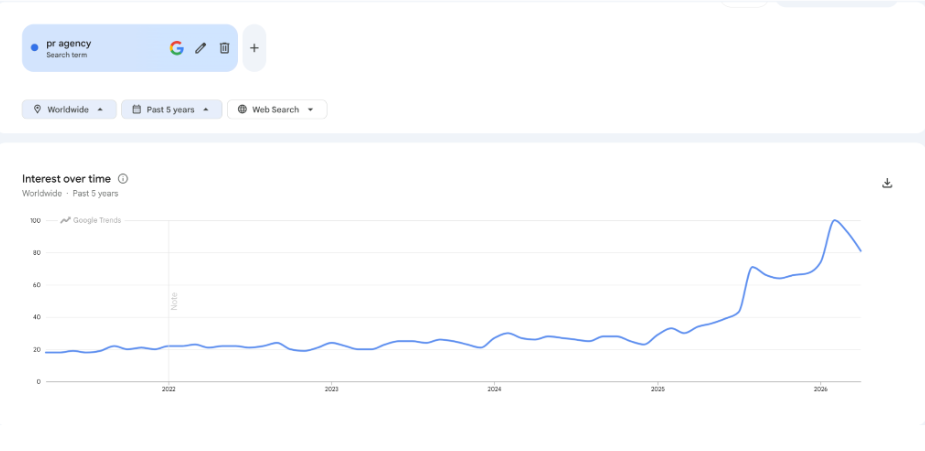
Why are PR Agencies enjoying a huge spike in interest? Well, that's because Large Language Models (LLMs) use the media as a source to select which companies to feature in their results. In fact, our recent research on the AI Visibility of Indonesian Banks and the AI Visibility of the Indonesian Automotive Industry both indicate that earned or news media is the dominant source of citations by LLMs.
So that's why all these companies are now going after PR agencies and PR professionals to be featured in the media because they know that AI use that media coverage to select which companies to feature in their results.
But simply throwing press releases at reporters isn't going to save you. The real threat staring down the C-suite isn't just visibility. It is narrative risk. Getting an AI to mention your brand is useless if the machine decides to tell a terrible story.
We are living in a zero-click reality. Users interrogate a AI chatbot, read the summary, and bounce. They rarely visit your website. Your reputation is entirely baked in before a potential customer even thinks about looking for a link.
If you sit back and let an algorithm figure out what your company is about, it will just scrape together whatever is lying around. It will pull an outdated product page, a random negative article, or a five-year-old pricing tier, and present it to your customer as the absolute, undisputed truth.
Waiting to see what an AI says about you before you manage the narrative is a guaranteed losing strategy. You have to control the source upstream. Don't forget that AI is not able to create things from scratch. AI is basically repackaging what's out there in the web.
Here is how that risk actually plays out, that every PR professionals should know.
We didn't just guess this was happening. At Maverick Indonesia we pulled the receipts to see exactly how generative AI search shapes reputation and trust the Indonesian banking sector. We threw hundreds of targeted prompts at six major LLMs to figure out exactly where they get their answers.
The data tells a pretty blunt story about who actually controls your brand.
Silence means total invisibility
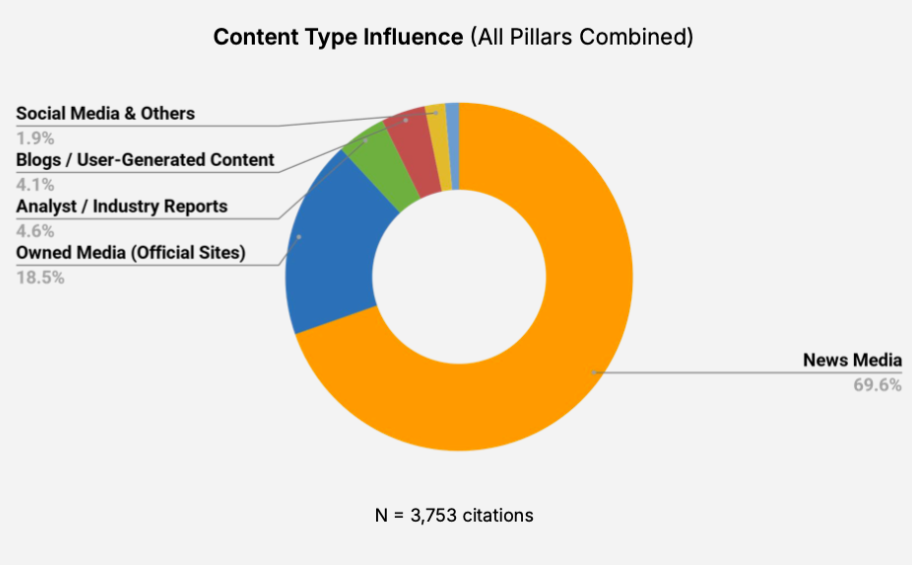
Nearly 70% of the citations AI spits out come from traditional news media. Specifically, top-tier outlets like Kompas, Bisnis, and Detik do the heavy lifting. If your PR strategy ignores these heavyweights, you practically don't exist to platforms like Gemini or Copilot.
You can't just throw up a nice corporate blog and pray. AI anchors its credibility on actual journalists. If you aren't fighting for earned media space, you have surrendered your narrative.
Bots tend to be positive (and that is a problem)
Our data showed that a measly 0.5% of AI citations were actually negative. Generative engines heavily favor positive or neutral synthesis. But that isn't a safety net.
Because AI mutes conflict and acts like a cautious curator, a single piece of negative coverage from a high-authority news site will sit there unchallenged. If the press runs one major story about a botched product launch or a compliance failure, the AI treats it as the absolute gospel.
You don't get a chance to argue in the comments section.
Zombie content will haunt you
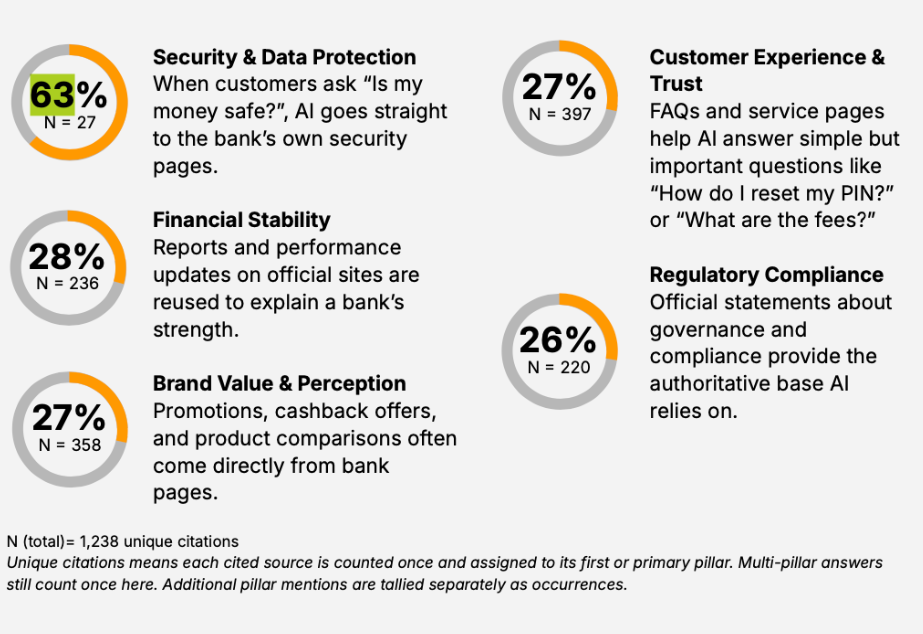
Then there is your own website. AI relies heavily on owned media for the boring, technical stuff that Earned Media aren’t likely to cover. For example, 63% of citations regarding security and data protection came straight from official bank sites rather than the press.
But AI has a long, stubborn memory. Nearly 30% of its citations are pulled from content older than 12 months. If your FAQ page is neglected, or your fee structure is from two years ago, the AI will confidently serve that zombie content to your customers as if it were published yesterday.
At the same time, LLMs also prefer recency in news items. So what this means is that you not only have the ensure that zombie content will damage your reputation, you also have to constantly get yourself in the news.
So, how do you actually win this game?
You stop treating PR like a megaphone and start treating it like narrative architecture. And you get proficient with Generative Engine Optimization (GEO).
This is one of the reasons why Maverick Indonesia launched MavGEO Services in October last year.
We didn't build it to track vanity metrics. It is specifically designed to help organizations track how generative AI answers actually describe their brand, identify exactly which sources are shaping those narratives, and map out how to improve visibility in this brutal new environment. Then it sets out to get AI to tell your desired narrative.
Control the source upstream. Because if you don't define your brand, the algorithm will happily do it for you.