The Long Game: Why Authenticity as well as strong SEO and GEO Fundamentals Are The Only Ways to Win in The AI Search Era
It gets the goat of my boss all the time.
Being one who tries to keep a pulse on the industry he occasionally searches Google and asks LLMs to list the top PR agencies in Indonesia.
Every time he does this he would rant at me, “See..this PR agency doesn’t have any real existence except online, but they list it as one of the top 10. All because they game the system by publishing a bogus list of top agencies and web crawlers lap it up.”
My boss will be very happy with Google’s latest feature.
Finally, Google has officially launched a feature to report websites that are found to be spamming. Yes, the cries of SEO professionals (and also, of course, my boss) have finally been heard by Google. In the end, authenticity, good SEO fundamentals, and now GEO as well, win in the AI search Era.
John Mueller, Webmaster and Senior Search Advocate Google, reminded website owners and SEO professionals that spam is not just a ranking issue, it is a TRUST issue. With its latest spam policy update, the search engine is tightening the rules around manipulative practices that try to game rankings instead of serving users.
To emphasize this strict stance, Google’s official documentation now explicitly states:
"Ranking manipulation techniques that attempt to compromise the quality of Google's search results violate our spam policies and can negatively impact a site's ranking."
More importantly, Google is now empowering users and SEO professionals to hold rule-breakers accountable. Their updated guideline reveals a powerful new mechanism:
“Google may use your report to take manual action against violations. If we issue a manual action, we send whatever you write in the submission report verbatim to the site owner to help them understand the context of the manual action. We don't include any other identifying information when we notify the site owner; as long as you avoid including personal information in the open text field, the report remains anonymous.”
To submit a report about a spamming website, you can go here: https://search.google.com/search-console/report-spam.
So, the question is what exactly does this kind of deceptive, rule-breaking content look like in the wild today, and which tactics are currently on Google's chopping block?
Let's break it down.
Examples of SEO Spam: What Google is Penalizing
1. The Bias of Self Proclaim “Best Of” Listicles
One of the most glaring examples of modern SEO manipulation is the self proclaim "Best Of" listicle (my boss’s pet hate). Most SEO experts hate this and it became an alarming trend for brands.
For example:
Type in google search bar: “best PR agency in Indonesia”, Google will show you this:
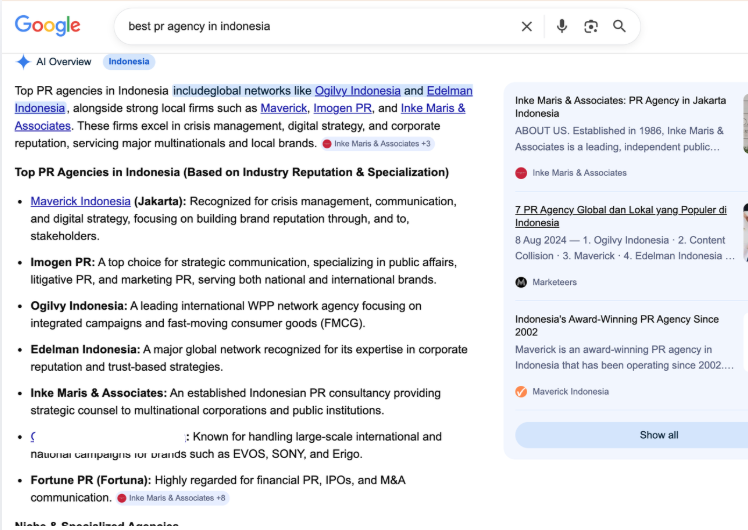
If you scroll down and look closely, you'll notice something odd about the AI Overview's recommendations.
Try clicking the blue link from the list of 'Top PR Agencies in Indonesia', and one of them will take you straight to a blog post on an Indonesian PR agency's website titled, '10 Best Indonesian PR Agency Recommendations':
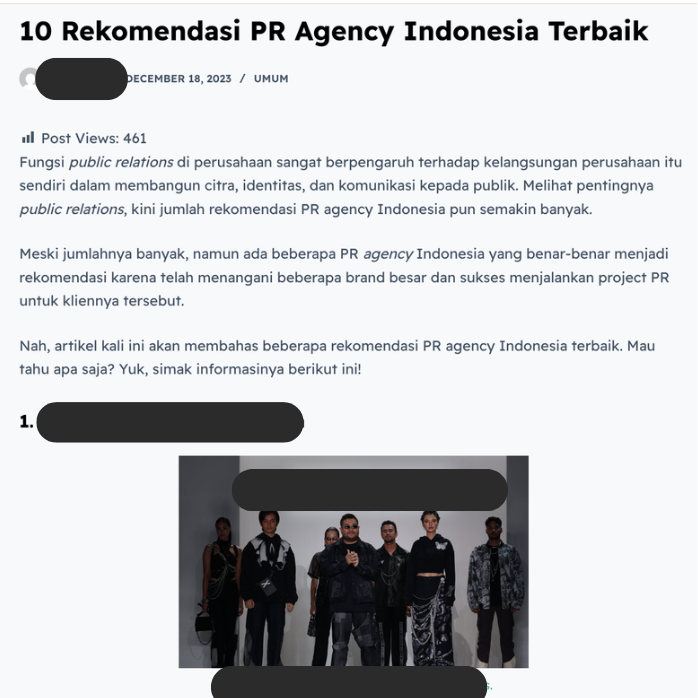
Guess what? Yes, in that blog post, the author placed their own agency at the number one spot as the best PR agency in Indonesia. This is known as a self proclaimed 'best of' listicle.
This is exactly the kind of spam Google is currently cracking down on. Mueller has repeatedly stated that quality reviews must demonstrate firsthand experience, authenticity, originality, and clear evidence of evaluation.
Overly promotional listicles often fall short of these standards, especially when their bias is not disclosed.
Barry Schwartz, Analyst and Editor of Search Engine Roundtable, conducted research to find out if Google actually takes action against websites that engage in this type of spam. He reported significant Google ranking volatility in January 2026, a couple weeks after the conclusion of the December 2025 Google Core Update.
“I was surprised to see sharp visibility declines across several large brands, all beginning around the same period,” said Barry.
Based on the type of content he saw most heavily impacted, this volatility reflects ongoing refinements to Google’s reviews system, which has increasingly focused on detecting self proclaim serving, biased, or low-evidence review content.
In my opinion this tactic attempts to hijack high-intent keywords while entirely bypassing objective analysis, third-party validation, or actual first-hand experience.
2. Fake Freshness Signals: Updating the Year, Ignoring the Content
Another widespread tactic that Google is actively hunting down is the manipulation of "freshness" signals. Have you ever searched for something like the "Communication Framework Guide 2026," only to click the link and realize all the screenshots, tools, and strategies discussed are clearly outdated and from 2023?
That is a fake freshness signal.
In a desperate attempt to maintain their rankings and attract clicks, many website owners use automated scripts or manual shortcuts to simply change the year in their article titles, H1 tags, or meta descriptions. They will instantly flip "Best Accounting Software for 2025" to "2026" at the start of the year without actually updating a single word of the core content, verifying if the software features have changed, or adding any new value for the reader.
3. Back Button Hijacking
Google now is taking a stand against this deceptive tactic by expanding its policies to punish sites guilty of back button hijacking.
Back button hijacking is when a website interferes with a browser so the back button no longer takes users to the previous page, instead often keeping them on the site or presenting unsolicited ads.
Google warns that trapping users ruins the natural browsing experience and causes deep frustration. When people feel manipulated, they lose trust and hesitate to explore unfamiliar websites.
To avoid incoming penalties, Google is urging site owners to audit their technical setups immediately. The mandate is simple: brands must ensure their site architecture never disrupts a visitor from freely navigating their browser history.
SEO in the AI Search Era: Why Authenticity is Your Ultimate Shield
As search engines rapidly evolve into AI driven experiences, the stakes for maintaining authenticity are higher than ever. Large Language Models (LLMs) rely heavily on the integrity of search indexes. If your website gets deindexed for spamming, you get erased from the AI conversation entirely.
On the flip side, building a trustworthy presence ensures strong AI visibility for your brand. AI engines are aggressively trained to value E-E-AT (Experience, Expertise, Authoritativeness, and Trustworthiness). Plus, we know that Google shows links in AI Overviews, meaning authentic content still drives highly valuable traffic.
So, how do you win? Go back to the basics and build an unbreakable foundation:
- Focus on True Experts: Let real experts write your content and provide original opinions that a machine cannot simply invent.
- Disclose Bias: If you review software or agencies, use independent methodologies. Trust is built on transparency.
- Integrate Communications: A solid strategy blending PR and SEO naturally builds the authority and brand mentions that AI systems crave.
In my point of view, the recent ranking volatility should serve as a massive wake up call.
Manipulative tactics are no longer just risky; they are a direct countdown to a manual penalty. Building a strategy around undeniable trust is the only way to win.